A glimpse into my world of food

Wednesday, June 20, 2012

Koji magic


I decided to look into koji after eating koji marinated pork at Ootoya, which opened a few months ago near Union Square. My mum was raving about it while I was back home and there has been a koji boom in Japan since last year. Until I did a bit of research I didn't know about the health benefits.

Koji is not a new thing in Japan. It's the essential ingredient for making all the iconic Japanese products including soy sauce, miso and sake. Apparently it was popularized in a food based manga, and I've also heard that the interest peaked shortly after the earthquake and tsunami of March 2011 because people became even more health conscious.

Koji is Aspergillus oryzae in English and is a fungus that derives from fermenting steamed rice, wheat or soybeans. You can buy dry koji rice to make either shio-koji (salted koji) or ama-koji (sweet koji).

Soy sauce and sake are typically pasteurized so the benefits of koji are lost. But by using koji rice as a condiment or marinade, you can get all the benefits from the live enzymes and live culture (lactobacillus). Koji can break down proteins into amino acids (including glutamic acid, responsible for umami) and starch into sugars. 

In fact, Nanbu Bijin has patented their no sugar added umeshu (ume plum sake), which is sweetened only with koji. This means their umeshu has a lot less calories and added sugars, hence is healthier. Other umeshu typically includes as much sugar as ume plums in weight. I don't think I can go back to drinking other umeshu after having tasted this stuff! Ama-koji can be used in place of sugar as a healthier alternative. It is made by cooking rice, folding in koji rice, and letting it slowly ferment in the rice cooker.


I was interested in shio-koji because of the ability of it to enhance umami in proteins. Apparently it's especially true when combined with chicken, which is high in protease, which is responsible for making glutamic acid. After marinating meats in shio-koji overnight, glutamic acid can increase by as much as 30%. It also has a tenderizing effect. The great thing about shio-koji is that you can greatly reduce the amount of salt you use because the umami is enhanced. Also, the result is a nice balance of saltiness with a hint of sweetness from the koji. 


The basic ratio for making salt koji is 3 to 1 (koji to salt). 


1.       Combine the salt and koji and place in a plastic container (avoid stainless steel or metal containers).
2.       Pour just enough water to cover the mixture. Keep covered and store in room temperature (during winter, store in a warm area for a week – 10 days and during summer store for about 5 days).

3.       The next day, it will have absorbed most of the water so add just enough water to cover the mixture and stir well.
4.       After the second day stir the mixture well once every day (but do NOT add more water).

5.       After 5 days (summer)- 10 days (winter), the fermented koji marinade will be ready to use.
6.       Use approximately 7-10% of the food weight in koji. For example, if you are marinating 1 lb of pork, marinate in 1.12- 1.6 oz of the koji mixture. 

7.       For vegetables (turnip, cucumber, cabbage etc), marinate for up to half a day. There is no need to wipe off the koji mixture.
8.       For meat and fish, marinate anywhere from 1 hour to half a day (varies depending on the protein and cut/size). Chicken wings only need to be marinated for 1-3 hours.
9.       The koji marinade burns quite easily so wipe off any excess marinade before cooking.


As you can see in the photo the pork that was marinated in koji looks like it nearly burned. I love the smell of cooked meat marinated in koji. It's like miso-marinated meats without the pungency. It's not as salty either, with a pleasant sweet finish. I only marinated this pork for three hours but I think the koji did wonders. It was more tender and obviously more flavorful than the pork I seasoned with just salt and black pepper.


I also marinated chicken wings for just a couple of hours and baked them in the oven. This was by far my favorite use of shio-koji. Hard to believe that just koji and salt with a bit of cracked black pepper can make something this flavorful!


Labels: , , , , , , , , , , , , , , , ,

Saturday, November 5, 2011

Japan Restaurant Review: Aronia de Takazawa


Aronia de Takazawa
3-5-2 Akasaka
Sanyo Akasaka Building 2F
(+81)03-3505-5052
reservation_a@aroniadetakazawa.com

After reading a blog about this restaurant I was dying to check it out.  We were lucky enough to get a reservation for Friday night (Nov 4th).  They are only open for dinner and the space seats a maximum of 10 guests.  I highly doubt they turn tables, meaning they only serve a maximum of 10 guests per night.  You have a choice of three different courses with 7,9, or 11 dishes (16,000, 20,000 and 24,000 yen respectively) and since the Chef purchases his ingredients based on reservations, you will incur a cancellation fee within three days of the intended date (60% for three days before to be exact).  So I asked for the 9 course meal and told the Chef that my mother doesn't like gamey meats or offals.  

It didn't help that the building in which the restaurant is located was under construction because the entrance is quite obscure and hard to spot. We pulled the door open, walked up the stairs and the first thing we saw was the Chef's stainless steel work station.  The room was decorated tastefully and it had a very clean look.  In the bathroom was the collection of "The Modernist Cuisine" books and cute tenugui (Japanese cloths) to wipe your hands with.  

The Chef cooked some of the items on the work station but it was mostly used for plating.  He had two cooks helping him in the back kitchen and his wife took care of the service.  I had seen plenty of photos of his dishes but didn't know how the food would taste.  I would say that this was one of the top five fine dining experiences I've had in my life.  Aronia de Takazawa did not disappoint, and the Chef's humbleness definitely added weight to the experience.  

The interesting thing about Chef Takazawa is that he never worked at a Molecular Gastronomy restaurant.  After graduating from culinary school, he worked at a high end restaurant at a hotel, at a yakitori restaurant and also did wedding banquets.  I read that his parents have been running a traditional Japanese restaurant in Tokyo for the past thirty years or so and his attention to detail and meticulous plating skills clearly reflect his connection to traditional Japanese cuisine.  He not only presents aesthetically beautiful food but also cares immensely about the ingredients he uses, and he apparently maintains good relationships with most of his purveyors (who are for the most part the actual farmers themselves). 

This is a detailed article about the Chef

  
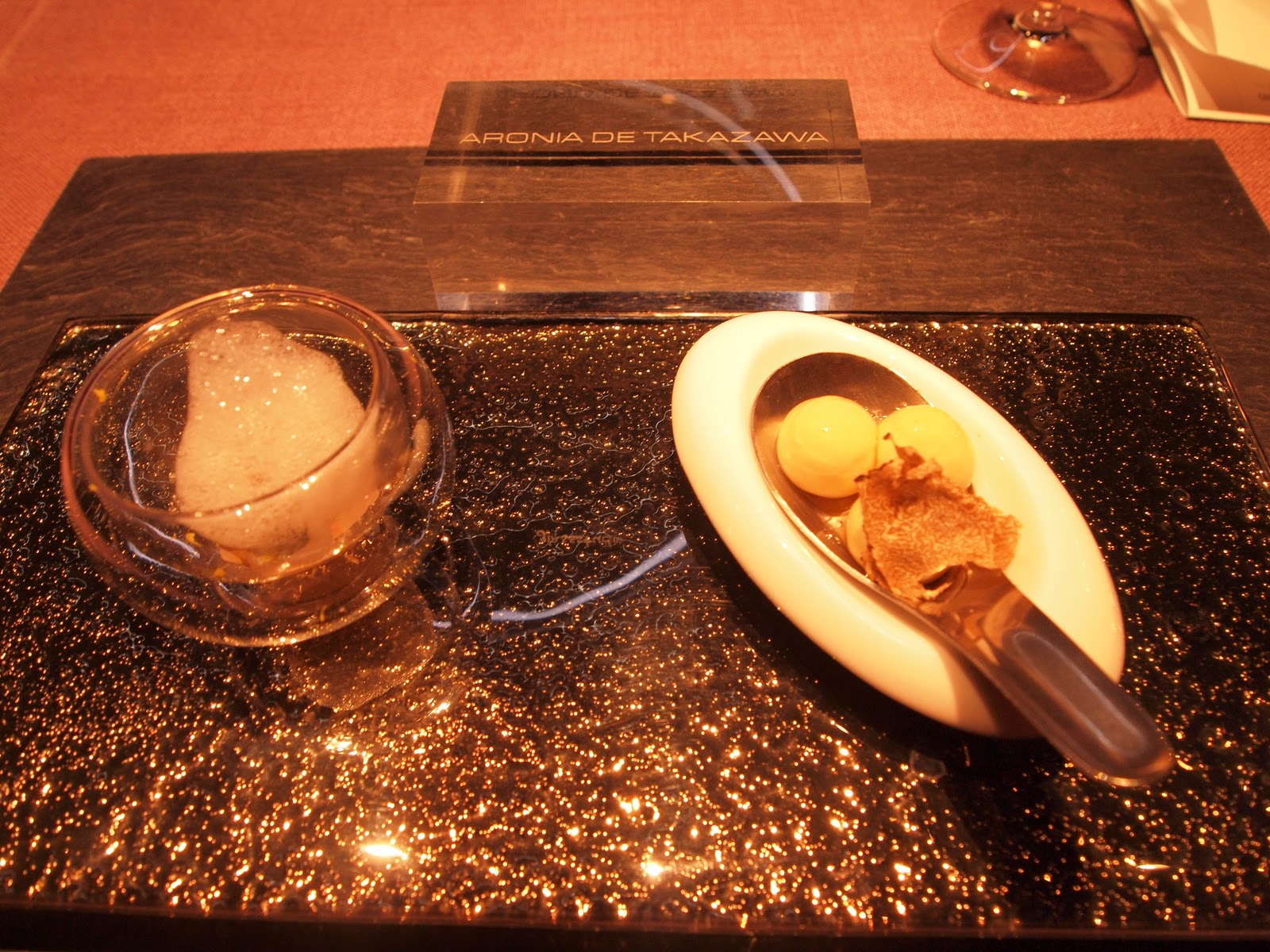
 The amuse bouche: Raw tachiuo (scabbard fish), kani miso (crab intestine) and yuzu foam (left) and liquid vichyssoise balls with black truffles

 First course: One of the Chef's signature dishes, "Ratatouille".  He cooks each of the fifteen different vegetables separately to achieve the best/prime texture for each one.  He told us to eat it in one bite with the small fermented black bean and piece of sea salt.  The salt was rather sweet (いやなしょっぱさがなかった)and brought out the umami in the vegetables.

 Second course: "Vegetable Parfait", the bottom layer was tomato water, followed by an orange tomato gazpacho, green tomato gazpacho, parmigiano reggiano mousse, caviar and a kale (cavolo nero) chip.  The mousse was surprisingly light and went very well with the acidity of the gazpachos.  We were told to mix everything together with the long spoon and use a straw towards the end.

 Carrot bread (hint of cumin.  REALLY good bread!) with pork rillette (using Agu pork from Okinawa), which was my absolute favorite
 Third course: "Bacon and egg?" Looks like a poached egg but is actually a soy milk mousse with a kabocha (Japanese pumpkin) filling.  Served with makomodake, popcorn and finished with a cold potato soup


 Fourth course: Saba (mackeral) with Inca no Mezame (purple) potato, finished with a powdery balsamic vinaigrette


 Fifth course: This is where you can see the Chef's playful side.  This is a play on コーヒーゼリー(coffee jelly, which we typically eat with heavy cream or half and half).  I think this dish would be more amusing to Japanese people because we have been brought up eating coffee jelly (I've never really seen it elsewhere).  What looks like coffee jelly is actually a mushroom jelly, with a foie gras mousse underneath.  It was served with this unbelievably flavorful mushroom sauce.  A very rich dish.

 After the carrot bread we got sesame bread (toasted on the grill)


 Sixth course: "Hot Balloon" A sealed bag of bubbling hot goodness.  Gomahata (a type of grouper) in a rich creamy mushroom broth and plenty of mushrooms.  A steaming hot dish perfect for cold weather.  The only negative comment I can make about the meal at Aronia de Takazawa is that perhaps mushrooms were overused.  I love mushrooms and they are in season but they seemed to make an appearance in half the dishes...


 Seventh course: "Truffle Hunt", another playful dish.  I love that there is a little story to this and it really looks like autumn! The black balls that look like truffles are croquettes, and there is a juicy tender tenderloin of pork (tasted almost gamey- the pigs must be living a great life outdoors) amidst dehydrated maitake (hen of the woods mushroom) and what looks like falling leaves (dehydrated mushroom risotto).

 Eight course: "Sainte Maure", a goats milk ice cream coated with black sponge cake to make it look like Sainte Maure de Touraine (goats milk cheese from France with a black-grayish rind)

 A candle for my parents' 30th marriage anniversary.  "Takazawa's Special Camembert".  What looks like camembert cheese is a truffle cheese cake (much lighter than it looks.  creamy but light in texture).  Served with a Manuka honey ice cream.  I thought the wooden cutlery was adorable!

 Had a choice from 12 teas (each with a different description like "after a long days work", "for mummy" etc).  The petit fours were adorable and yummy.  From right to left, a yuzu marshmallow, mini salted chocolate bar, coconut cookie and matcha financier.


I had four glasses of wine, three of which were Japanese wines.  The first was a Chardonnay from Yamanashi (melon in the nose with minimal malolactic fermentation.  Not as crisp as Chablis type Chardonnays but not as buttery and full like typical Cali Chardonnays either).  The second was a light bodied Muscat Bailey (red wine)- low acidity, rose syrup in the nose- very aromatic but I was not a big fan.  The last was a 2004 Cabernet Sauvignon and Merlot blend also from Yamanashi (Chateau Mars), which was my favorite.  

After we were done with our meal and paid the bill, the Chef and his wife came downstairs and outside with us to make small talk, thank us and say goodbye.  This is what I love about the fine restaurants in Japan.  The interaction guests can have with the Chef.  Most chefs of fine restaurant establishments will come greet the guest at the end of a meal, which is something I have never experienced at restaurants in New York.  When I went to Quintessence in Tokyo (three Michelin star), the Chef (very young and humble) came to say goodbye and ask how our meal was.  Aronia de Takazawa does not have any stars but the experience I had was comparable to that of places like Quintessence and Arzak.  It's hard enough to get a reservation so it's probably a good thing that it has no Michelin stars.  The Chef probably doesn't want to sell out either so I'll hope that he can get by with the way he has been doing things for the past six years.  Will definitely go back again one day. 

Labels: , , , , , ,

Tuesday, June 17, 2008

Japan Restaurant Review: 強羅花壇 (Gora Kadan Inn)

Gora Kadan Inn
1300 Gora, Hakone, Ashigarashimogun, Kanagawa, JAPAN
+81-460-82-3331

Despite Gora Kadan's somewhat modern take on Hot Spring Inns (with the Westernized spa services and modern architechture), the kaiseki dinner they serve is very traditional. The course includes more than 10-15 small dishes and they always use the most seasonal ingredients to express the season. Their umeshu (plum wine) is my favorite; I think the hint of brandy makes it more fragrant than most plum wines. There is nothing more relaxing than enjoying a full kaiseki course meal before, and/or after a long bath in one of the hot springs. The food is not only fresh and delicious, but aesthetically pleasing as well.

Private rotenburo (outdoor bath)


An appetizer: snapper with various vegetables (broad bean, Japanese mountain yam, carrot etc.)

Abalone sushi


Ginnan Shinjou (Ginko nut soup with a light minced prawn ball)


Assortment of sashimi: Ise Ebi (Japanese lobster), Toro (fatty tuna) and Hirame (halibut)

Grilled Sawara (Spanish Mackeral) with a miso glaze

Braised tender pork croquette


Labels: , , , ,